Many people use game accelerators for the first time with a straightforward thought: "After turning it on, my network will be faster, and the game won't lag."
However, those who have actually used them for a while usually find that it's not that simple. Sometimes, turning on the accelerator does reduce latency and makes gameplay smoother; other times, there's little difference between having it on and not, and you might even wonder if you've paid a "stupidity tax." This is why the topic of "do game accelerators actually work?" is always a hotly debated one.
The key issue is that many people equate "fast internet speed" with "better gaming experience." In reality, these are often not the same thing. Your broadband speed test might look great, and downloads might be fast, but once you enter the game, you'll still encounter high latency, ping spikes, character teleportation, inability to use skills, or even inexplicable disconnections. This is especially noticeable when playing international servers, cross-region servers, or during peak evening hours.
Therefore, to truly clarify this, we need to rephrase the question: What exactly does a game accelerator "accelerate"?

I. Why Does My Gameplay Still Lag Even When My Internet Speed Isn't Slow?
Many players' first judgment of their network speed is based on speed test results. For example, a broadband speed of 300M, 500M, or even 1000M seems fast, so naturally they think: "My internet is good, so why is my game still lagging?"
The problem is that the network requirements for games are completely different from downloading files or watching videos.
When watching videos, the platform caches content in advance. As long as your overall network throughput is sufficient, you might not even notice occasional fluctuations. Downloading files is even more straightforward; the key is whether the bandwidth is large enough and the speed is high enough.
But games are different. Games, especially online multiplayer games, emphasize real-time interaction. Every button press, every step, every shot fired, every skill used is essentially a continuous exchange of data with the server. If there's even a slight disruption in this connection, it will immediately be reflected in the user experience.
This is why many people encounter a typical situation: videos play smoothly, web pages load quickly, but as soon as they enter a game, ping spikes, and their character even seems to be "drifting."
Therefore, game lag isn't necessarily due to slow internet speed; often, it's because the connection isn't stable enough.
II. The Root Cause of Game Lag Isn't Often "Insufficient Bandwidth"
If we break down the term "internet speed," it actually encompasses many different concepts. While everyone is most familiar with download speed, it's usually not the most crucial factor for games.
What truly impacts the gaming experience are often the following:
1. Latency
Latency is how long it takes for your sent action to be received by the server and for the result to be returned to you. The longer this time, the more likely you are to feel like "my buttons aren't responding."
2. Packet Loss
Packet loss can be understood as data getting lost in transit and not being successfully delivered. In games, this usually manifests as sudden character teleportation, skill malfunctions, no feedback when firing, and the character's position inexplicably shifting back.
3. Jitter
Jitter is different from simple high latency. Its problem lies in its instability. For example, sometimes it's 30ms, sometimes it suddenly jumps to 120ms and then drops back down. Even if the average isn't high, it makes playing games extremely frustrating.
4. Connection Stability
This is also a point many people easily overlook. Some networks aren't consistently slow, but rather experience intermittent spikes, drops, or lag. This experience is often more annoying than consistently high latency.
Therefore, what games truly fear isn't just "slowness," but "instability." This is why you often see a situation where speed tests are normal, but the game is still unplayable. The reason isn't insufficient bandwidth, but rather the poor quality of the transmission link between you and the server.
III. What Exactly is a Game Accelerator?
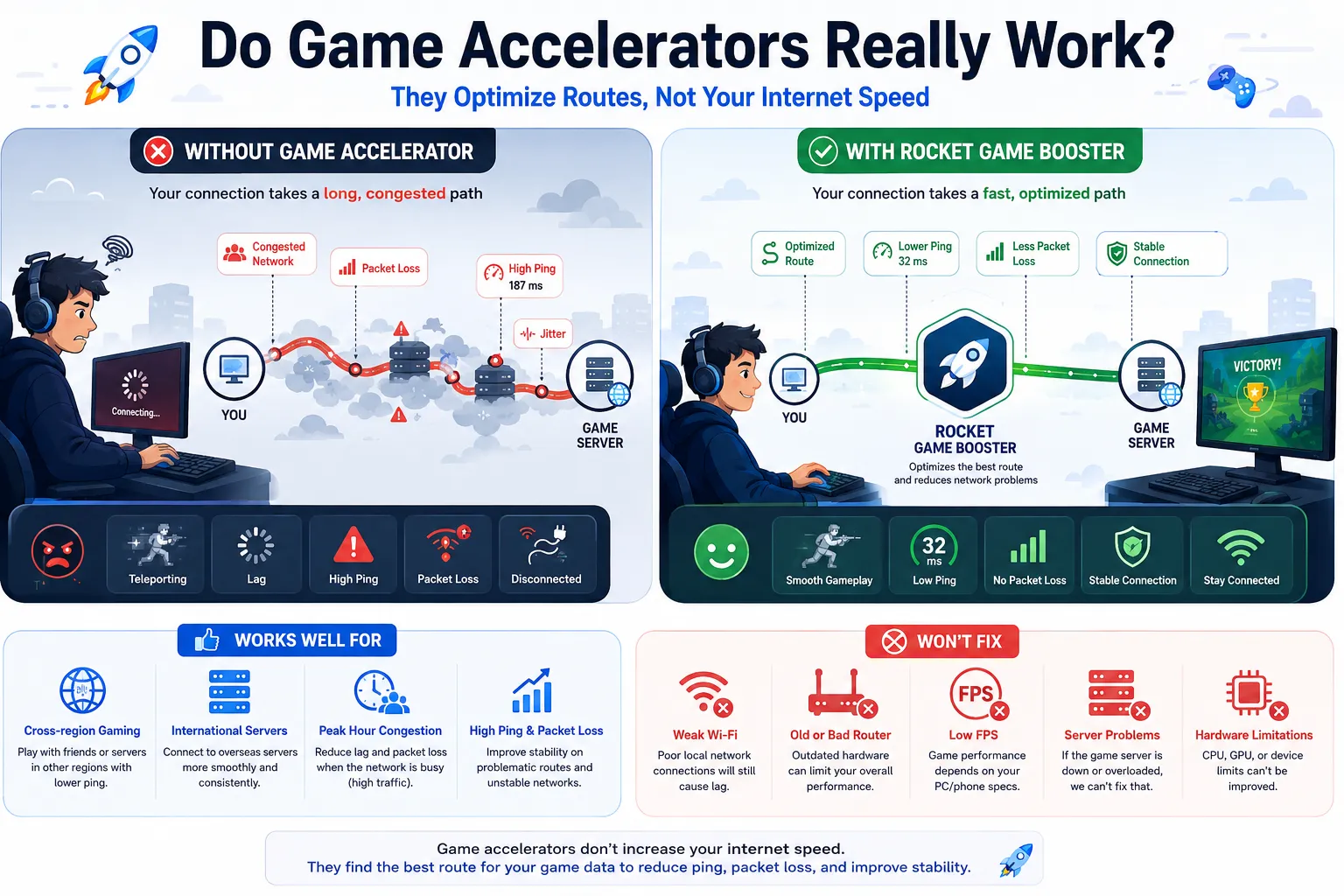
In short, a game accelerator doesn't simply make your internet faster; it helps your game data find a more suitable route.
This might sound abstract, but it's actually easy to understand. You can imagine your connection to the game server as driving to a destination. Theoretically, you can always get from home to your destination, but the default route your navigation system gives you isn't necessarily the best. It might be a longer route, there might be traffic jams, the roads might be rough, or a section might be particularly prone to problems.
The same applies to the network. After your device's game data is sent out, it doesn't instantly "fly" to the server; instead, it passes through many intermediate nodes, many ISP links, and many different network devices. If any one of these segments is unsatisfactory, the experience will be ruined.
The role of a game accelerator is to add a smarter intermediary layer between you and the game server. It doesn't necessarily change your home bandwidth, but it tries to avoid those poor-quality, congested, and fluctuating paths, directing game traffic to a more suitable route.
So it's more like "building roads" and "navigating," rather than suddenly adding extra horsepower to an engine.
Incidentally, it's also worth mentioning that it's not the same as a regular proxy or VPN. While they may superficially appear to be just "relays," game accelerators focus more on the game traffic itself. Their goal is clear: to make game connections more stable and smoother, rather than simply acting as general proxies or providing privacy-focused data transmission.
IV. How Game Accelerators Work
The underlying principle isn't as complex as it seems. Breaking down the process, it boils down to these steps:
1. The player's device first connects to the accelerator node.
When you open the accelerator and select a game and server, your device won't directly search for the game server using the default path. Instead, it will first connect to a node assigned by the accelerator.
This node is usually closer to your current network environment, or at least it's the entry point that the accelerator determines is more suitable for your current network connection.
2. The accelerator selects the optimal path based on network conditions.
This is where the accelerator truly shines. Based on its knowledge of node status, network congestion, regional distribution, and ISP interconnection quality, it tries to select a more stable route for you.
The crucial point here is: A default connection doesn't necessarily mean it's the optimal one. Often, your original route might be playable, but it's just a longer, more congested route, or suffers from significant packet loss in certain sections. The value of a VPN lies in providing an alternative.
3. Bypassing Congested, Detour-Oriented, or Poor-Quality Links via Relays
If the "default highway" directly from your home to the game server is problematic, a VPN will route your data via its "relay highway." Sometimes the problem isn't at the starting point or the destination, but rather the unstable quality of the long public network path in between. Through relay nodes and optimized routes, VPNs can often bypass these pitfalls.
4. Delivering Data to the Game Server More Stably
Finally, the data is sent to the game server via this optimized path. While this adds an extra layer, the overall route quality may actually be better, resulting in a smoother experience.
Many people instinctively think that "relay" means an extra step and should be slower. This idea seems reasonable at first glance, but it's not always the case in reality. In reality, network speed isn't determined by the shortest straight-line distance, but rather by the quality of the link and the smoothest path. Sometimes, what seems like "taking an extra step" can actually be more stable and faster.
V. What Does It Really Optimize?
If I had to summarize what game accelerators actually optimize, I think it can be summarized in four words: not speed, but quality.
It primarily improves network connection quality, rather than simply increasing a certain number.
Let's start with the easiest to understand: latency. Especially when playing on international servers or cross-region servers, the default routes can be quite convoluted. Accelerators, through more efficient relaying, can indeed reduce latency.
But more important than "how much lower the latency" is often its improvement in packet loss and jitter. Because what truly affects the gameplay experience is often not the drop in ping from 60 to 45, but rather the stability of the game, where sudden spikes used to occur frequently, skills no longer malfunction inexplicably, and characters no longer teleport frequently.
So if you ask what the true core value of a game accelerator is, I would say it's not "driving the numbers down ridiculously low," but rather making the connection more controllable and stable
Especially in complex environments like cross-regional connections, cross-carrier connections, and peak evening hours, "stability" is often more important than "low." A stable 70ms connection is often much better than a connection that fluctuates wildly between 35ms and 150ms.
VI. Why is it sometimes ineffective even with an accelerator?
This part is also very important because many people have misunderstandings here: Why is it not working even though I've turned on an accelerator?
The reason is usually not something that can be summarized as "this thing is useless," but rather that the problem you're encountering may not be within the scope of its capabilities.
1. Problems with your local Wi-Fi or broadband itself
If your local network is already unstable, for example, due to a weak Wi-Fi signal, too many walls in your house, an old router, severe wireless interference, or someone in your house competing for bandwidth, then the problem may have already occurred before the data leaves your home.
In this case, the accelerator can only do so much. To put it bluntly, if the road in front of your house is in terrible condition, even the best highway repairs won't fully fix it.
2. Poor Game Server Status
Another possibility is that the game server itself is in poor condition. This could be due to fluctuations in the official server room, high server load, temporary maintenance, or network anomalies. If the endpoint is unstable, no amount of optimization of the intermediate routes can completely eliminate the problem.
3. Incorrect Node Selection
This is also a common reason. The same accelerator can have different effects depending on the node, mode, and time of day. Sometimes, automatic selection isn't the best fit for your current ISP and region; manually changing the node can significantly worsen the experience.
4. Device Performance Issues Mistaken for Network Issues
Many people refer to any "lag" as "lag," but network lag and frame drops are completely different. If you experience choppy visuals, low frame rates, frame drops during team battles, or stuttering when changing perspectives, it's likely not something an accelerator can solve. It can't improve graphics card performance or reduce CPU load.
Therefore, if a game accelerator doesn't work, it doesn't necessarily mean it's completely worthless; it's more likely that the problem you're facing isn't one it excels at handling.
VII. In which scenarios is a game accelerator more worthwhile?
Ultimately, a game accelerator isn't necessary for everyone, but in certain scenarios, its value is more readily apparent.
For example, if you frequently play on international servers or cross-region servers. In these situations, you and the server are inherently far apart, the intermediate path is complex, and the probability of a suboptimal default network connection is higher. An accelerator is usually quite useful here.
Another example is if you often play games during peak evening hours. It might be fine during the day, but at night, with everyone online and using the internet, public network links become congested, and applications like games, which are sensitive to real-time performance, are particularly vulnerable. If an accelerator can help you bypass congested periods, the difference is usually quite noticeable.
Another situation is when the interconnection quality between different ISPs is poor. For example, if your home broadband belongs to a certain ISP, but the connection between your network and the target server's connection is not ideal, you may experience a situation where "speed tests are normal, but the game is not smooth." In this case, an accelerator is more meaningful than simply focusing on bandwidth numbers.
If you frequently experience high latency, packet loss, ping spikes, or teleportation, especially if these issues are intermittent, the problem likely lies in the network path quality. If an accelerator has better network connections, it can potentially help.
VIII. Conclusion: Game accelerators aren't a panacea, but they can indeed solve a class of problems.
At this point, the answer is quite clear.
The working principle of a game accelerator isn't simply to "increase your internet speed," but rather to optimize the transmission path between you and the game server. It selects routes, schedules relays, bypasses congestion, and reduces fluctuations, ensuring your game traffic takes a more suitable path for real-time communication.
This is why it's sometimes very useful and sometimes less so. Because it addresses network link quality issues, not all "game lag" problems.
If your problems stem from cross-regional connectivity issues, network congestion, packet loss, jitter, or poor quality across different carriers, then a game accelerator is often worth trying. However, if your problem is poor local Wi-Fi, insufficient computer performance, or server crashes, then it's unlikely to be a panacea.
Therefore, I've always felt that the most accurate understanding of a game accelerator isn't as a "speed-up tool," but rather a "network optimization tool." It may not necessarily make your broadband numbers look better, but it can potentially make your gaming experience more stable and smoother.
And for gamers, what's truly valuable often isn't the seemingly lower ping number, but rather the fact that you no longer have to worry about a sudden drop while playing a game.