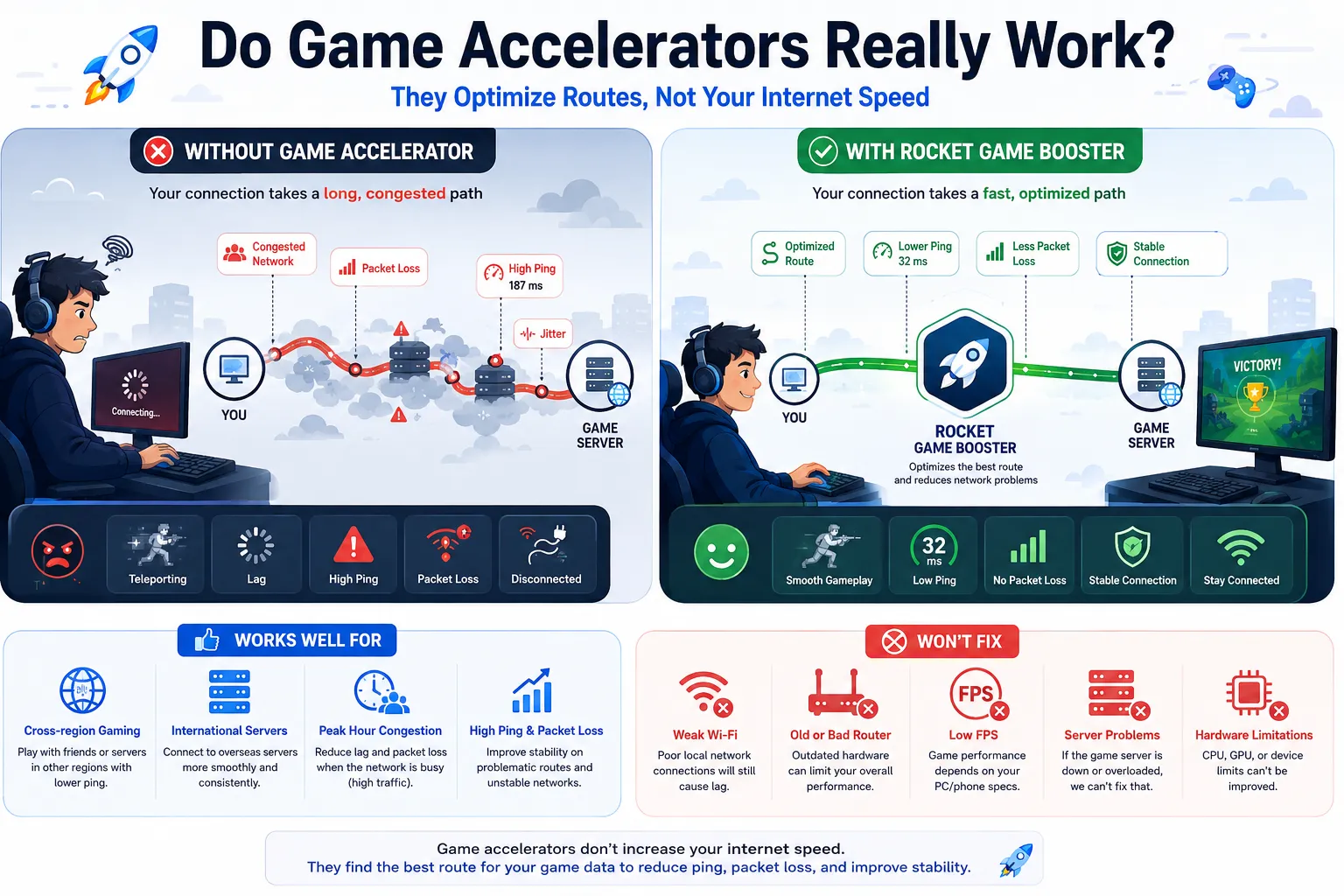
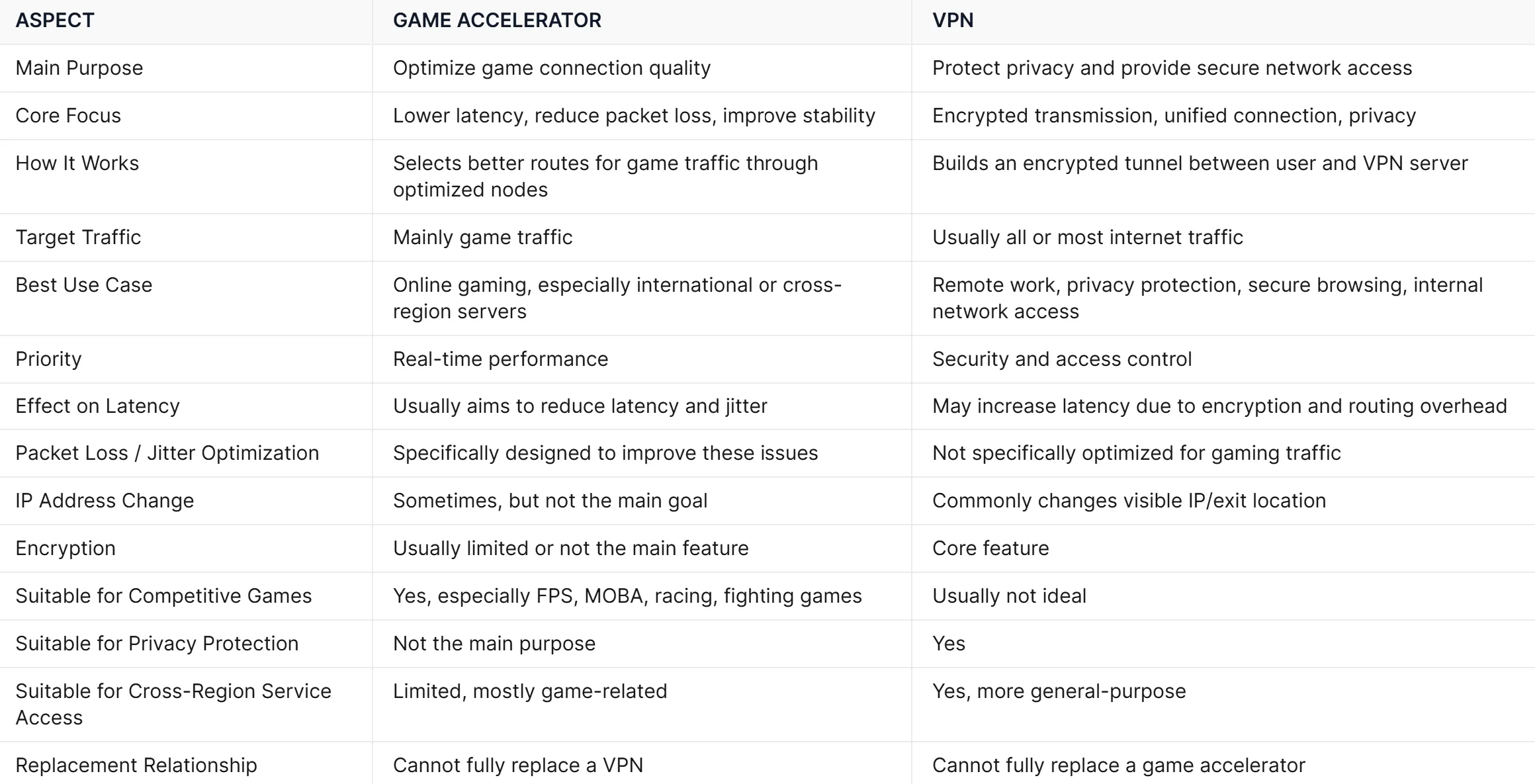
For mobile gamers or those who need to play with friends overseas, a "game booster" (or gaming VPN) has become almost essential. Whether it's aiming in *Free Fire* or coordinating teamwork in *Clash of Clans*, high latency and packet loss are always the most frustrating issues. The emergence of game boosters has indeed gone a long way toward solving these network pain points.

However, many players share the same question: Could using a game booster get my account banned? After all, there are occasional stories of "getting falsely banned for using a booster." Today, let's take an objective look at this topic from the perspectives of technical principles, developer attitudes, and real-world cases.
How a Game Booster Works
To determine if a booster is safe, you first need to understand what it does — and more importantly, what it *doesn't* do.
The core working principle of a booster is simple: when your game's data packets are ready to be sent to an overseas server, the booster selects a shorter, smoother route (usually a dedicated line or VPN tunnel) instead of letting the data "take the long way" across the public internet. The entire process only changes the physical path of data transmission. It does not read, modify, or inject anything into the game's local memory or files.
This is a crucial point. In contrast, cheats or modders directly tamper with game code or memory values, while a booster stays strictly at the "network layer." Think of it like driving: your GPS gives you a faster route, but you're still in the same car, using the same gas — fundamentally, no rule-breaking changes have been made.
In Most Cases: Reputable Boosters Will Not Cause Bans
In fact, the vast majority of mainstream commercial game boosters have proven their safety over many years of operation. Quite a few well-known game developers have explicitly stated that they allow the use of network optimization tools.
- Riot Games developers have publicly stated that it's perfectly acceptable for players to use VPNs or boosters to reduce latency, as long as they aren't used to bypass regional restrictions and buy games from cheaper regions.
- Valve (Steam platform) has a relatively neutral attitude toward boosters and will not flag an account as violating rules simply because of an IP change. Their VAC (Valve Anti-Cheat) system has never blacklisted legitimate boosters.
- Blizzard similarly tolerates players using boosters to play foreign servers of games like *Overwatch* or *World of Warcraft*.
Numerous player experiences confirm that using well-known paid boosters for thousands of hours results in completely normal account status. Therefore, for the vast majority of mainstream games, a legitimate booster itself will not cause a ban.
In Rare Cases: Account Risks Do Exist
Although the probability is very low, there are specific scenarios where using a booster might pose account risks. These risks don't come from the booster "actively doing something bad," but rather from changes in network characteristics.
1. Frequent IP Changes Triggering Unfamiliar Location Risk Controls
Many gaming platforms (especially Steam, Epic, and Ubisoft) have protection mechanisms for logins from unfamiliar locations. If your booster assigns you to nodes in different cities or even different countries every time you use it, the platform may think your account is "logging in repeatedly from unusual locations" and ask for email or SMS verification. While this isn't the same as a ban, frequently triggering these controls could lead to security reviews.
2. "Guilt by Association" Risk from Shared IP Pools
To improve resource utilization and reduce costs, most boosters use shared IP pools — meaning multiple users share the same outgoing IP. If one of those users uses cheats, fraudulently uses blacklisted payment methods (chargebacks), or engages in malicious behavior from that IP, that IP could be flagged as "high-risk" by the game server's anti-cheat system. You, who have nothing to do with it, could also be misjudged, although this situation is extremely rare.
3. Being Misjudged as Malicious Traffic by Anti-Cheat Systems
Some particularly strict anti-cheat systems (like BattleEye, EAC, or Xigncode3) are highly sensitive to abnormal, non-standard packet patterns. If your booster's node experiences significant network quality fluctuations or frequently retransmits data during route switching, in very rare cases, it could be mistaken for "simulated packets" or "attack behavior," triggering a ban. This is an extremely low-probability false positive, and you can usually appeal it.
4. Violating the Terms of Service for Region-Locked Games
This is the real "red line." If you use a booster (or VPN) to forcibly connect to a game server that explicitly prohibits access from non-local players (for example, some Korean MMOs require a local phone number for verification), your account will almost certainly be permanently banned if detected. For example, the Russian server of *Lost Ark* and the Korean server of *Aion* have strict restrictions on overseas IPs. In these cases, the reason for the ban isn't "using a booster," but "violating the region's terms of service."
Which Behaviors Actually Endanger Your Account?
Compared to using a legitimate booster, the following practices are genuinely high-risk and players should be extremely wary of them:
- Using free boosters or "cracked" boosters from unknown sources: These programs may contain malicious code, keyloggers, or crypto-mining scripts, or even actively upload your account credentials.
- Using a booster and cheats/scripts simultaneously: Many mistakenly believe using a booster makes cheating safer. In reality, anti-cheat systems only recognize behavioral patterns; a booster won't help "hide" your cheating.
- Using a booster to buy games across regions at lower prices: Frequently switching store regions to buy games from cheaper regions like Argentina or Turkey is a serious violation of platforms' user agreements (like Steam). The minimum consequence is game removal; the maximum is an account ban.
How to Use a Booster Safely and Minimize Account Risks
If you want to enjoy low latency while minimizing account risks, follow these suggestions:
1. Choose a well-known paid booster: Reputable companies have better IP management and appeal processes.
2. Prioritize "dedicated IP" or "fixed node" modes: Many boosters offer fixed outgoing IPs or exclusive lines (often for an extra fee), which can significantly reduce risk control issues caused by frequent IP changes.
3. Be aware of regional restrictions for your target game: Before boosting for Japanese or Korean servers, confirm whether the game prohibits overseas IPs. If the official policy explicitly forbids it, do not attempt it.
4. Enable two-factor authentication (2FA) on your account: Even if a login from an unfamiliar location triggers a security check, having mobile verification allows you to quickly resolve it, while also enhancing overall security.
5. Do not run multiple boosters or proxy tools at the same time: Avoid conflicts at the network layer that could lead to data anomalies.
VII. Special Case Analysis: Different Developer Attitudes
Tolerance for boosters varies significantly between developers. Here is a summary of several major developers' attitudes and key points to note:
- Riot (Valorant / League of Legends): Relatively tolerant, allows network optimization, but strictly prohibits changing account regions.
- Valve (Steam / CS2 / Dota 2): Neutral attitude, does not actively intervene. The VAC system does not target boosters, but frequent cross-region purchasing will lead to bans.
- Activision Blizzard (Call of Duty / Overwatch): Neutral towards boosters, but strictly cracks down on cross-region registration via VPN or purchasing from cheaper regions.
- Nintendo / Sony (Switch / PS online play): Tolerant attitude. Using a booster does not affect accounts, but caution is needed when switching account regions.
VIII. Conclusion and Summary Recommendations
Overall, for the vast majority of players, using a legitimate game booster poses a very low, almost negligible risk to your game account. Network boosters only optimize the transmission path; they do not modify game content and are not part of any anti-cheat system's ban logic.
The things you really need to be wary of are:
- Risk control triggers from shared IPs (usually just verification, doesn't affect the account)
- Boosting behavior that violates a game's regional rules (the most common, yet most avoidable, reason for bans)
- Using low-quality or illegal boosting software
Therefore, if you plan to use a booster for normal cross-region online play or to reduce latency, go ahead and use it with confidence. As long as you choose a reliable product, follow the game's regional rules, and enable account security protections, your account will almost never be affected by the booster itself.