Are game accelerators really effective?
This is a topic that easily sparks debate.
Some people feel that turning on an accelerator significantly reduces latency and makes games run much smoother; others feel they've spent money but the result is almost the same as not using one, even suspecting it's just a placebo effect. Especially in various communities, forums, and comment sections, the discussion about "whether game accelerators are useful or not" has been almost constant.
The reason for such a large divergence isn't because someone is exaggerating, nor is it necessarily because anyone has been "ripped off," but because this question itself cannot be answered simply with "useful" or "useless."
A more accurate statement would be: game accelerators are indeed effective in some scenarios, but they are not effective for all lag issues.
If you treat it as a "universal network patch," you'll likely be disappointed; but if you understand which types of problems it solves, you'll understand why some people can't live without it, while others don't feel any difference at all.
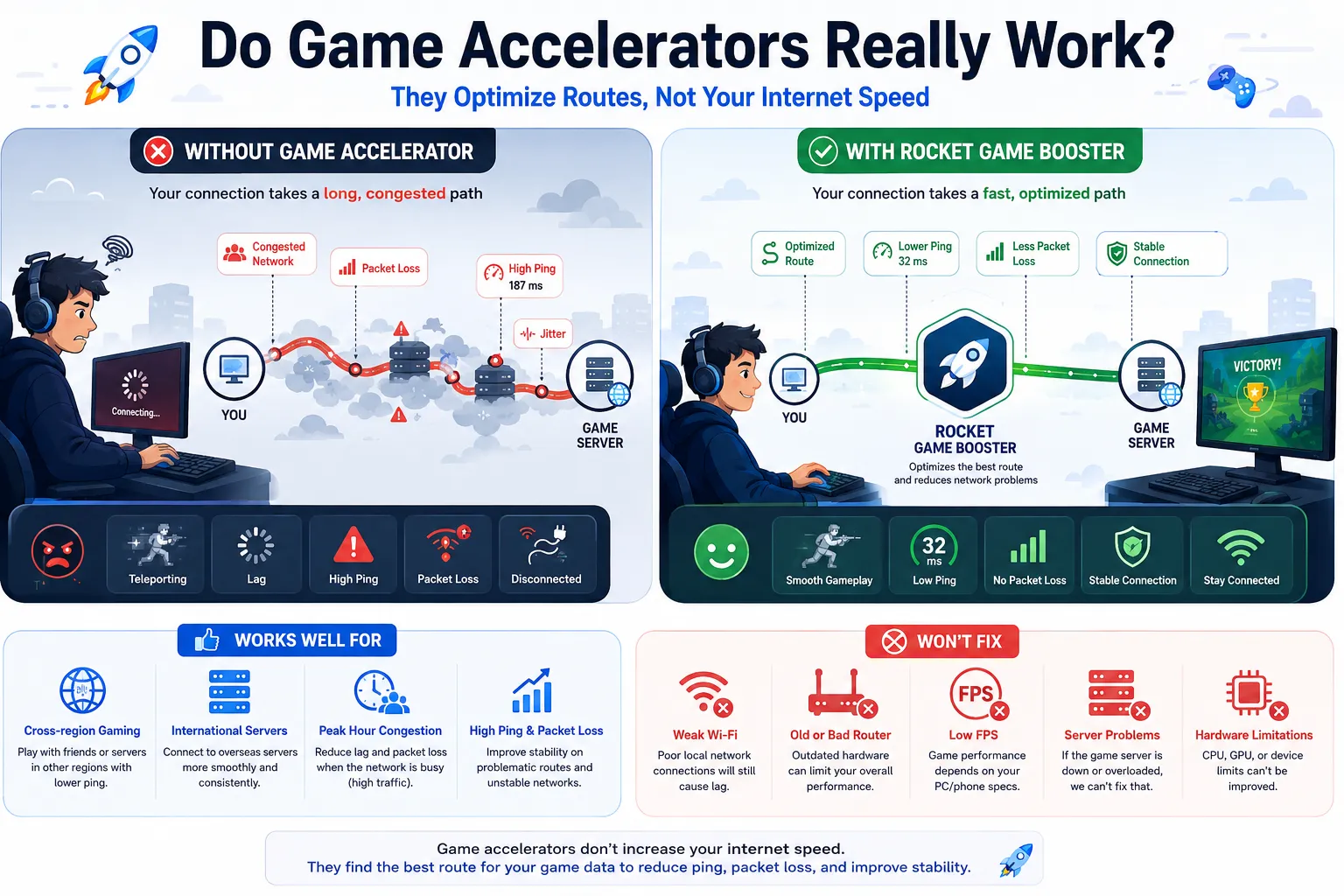
In conclusion: game accelerators don't magically speed up your broadband; rather, in certain situations, they help your game data take a more suitable route.
I. Is your problem actually a network issue?
Many players experience "lag," but it's not the same type of lag.
1. Network Lag
This usually manifests as delayed character movements, delayed feedback after firing, unresponsive skills, and sometimes even character teleportation, disconnections, and high ping. This issue is mostly related to network transmission.
2. Device Lag
Some people experience lag due to frame drops, choppy camera movements, or sudden frame rate drops during team fights. This is more likely a device performance issue—such as a problem with the graphics card, CPU, memory, or overheating—rather than a problem with the network itself.
3. Server Lag
Another possibility is server issues, such as queuing, abnormal latency, rollbacks, or disconnections. Even if your local network is fine, the experience will still be poor.
The problem is that these types of "lag" feel very similar. As a result, many people immediately think of using a VPN when they encounter problems, only to find it doesn't help, and then conclude that VPNs are useless.
However, if you're solving the wrong problem, the tool itself won't work.
Therefore, before discussing whether game accelerators are effective, the most important step is to first determine: is the problem you're encountering actually something the tool can handle?
II. What Do Game Accelerators Actually Do?
Many people's most intuitive understanding of accelerators is "increasing internet speed." This isn't entirely wrong, but it's not entirely accurate.
What game accelerators do is not the same as download acceleration or bandwidth improvement. What they truly affect is the network transmission path.
Simply put, every action you take in a game, such as moving, firing, using skills, or issuing commands, must first be sent from your computer or phone to the game server, and then the server returns the result. This process heavily relies on real-time communication. If the quality of any segment of the network connection is poor, high latency, packet loss, and jitter can occur, ultimately making you feel that "the game is laggy."
Under normal circumstances, your network data follows the default path assigned by your ISP. The default path works, but it's not necessarily the best for the game. It might take a detour, it might be congested at certain nodes, and it might perform poorly when transmitting across regions, ISPs, or countries.
1. First, connect to the accelerator node.
The accelerator will first connect your game data to its own node network, essentially guiding you to a more controllable channel.
2. Then, select a more suitable route.
Next, the accelerator will consider factors such as network congestion, node quality, and regional distribution to select a smoother route to send the data to the target server.
3. The core is not "instant speed boost," but "optimized route."
You can think of it as navigation software. There's never just one path from point A to point B on a map, and the default route isn't always the best. What the accelerator does is help you avoid congested areas, detours, and poor-quality routes.
Therefore, it's more about "optimizing the route" than "instant speed boost."
III. In what situations are game accelerators usually effective?
If your problem is indeed with the network link, then the accelerator is often effective, especially in the following scenarios.
1. Playing on international or cross-region servers
This is arguably the most common and valuable application of game accelerators. The distance between you and the server is already significant, potentially passing through network nodes in different countries and from different ISPs. A longer path naturally increases instability. If the default network connection is also suboptimal, high latency, packet loss, and teleportation issues can easily occur.
A game accelerator, by using more suitable relay paths, can often make these cross-regional connections more stable. It may not reduce latency to extremely low levels, but it often minimizes fluctuations and improves the overall experience.
2. During peak network congestion
Many people experience this: gaming is fine during the day, but at night, ping spikes, lag, and packet loss occur. The reason is simple: peak hours are the most congested time on the public network. If the default network is congested, your game data is easily affected.
In this situation, if a game accelerator has more available and stable alternative lines, it can be very helpful. Many players feel that "it's unnecessary to turn it on during the day, but you can't do without it at night," and this is precisely the reason.
3. When the connection quality is poor across different carriers
Network quality isn't just a problem with your home broadband itself; it also depends on the network path the target server uses. For example, if you have broadband from a particular carrier, and the connection quality between you and the game server's network is generally poor, even if your local speed test is normal, you might still experience an uncomfortable gaming experience.
In such cases, if an accelerator can connect the data to a more suitable node first, and then send it out through a better network, the effect can be very noticeable.
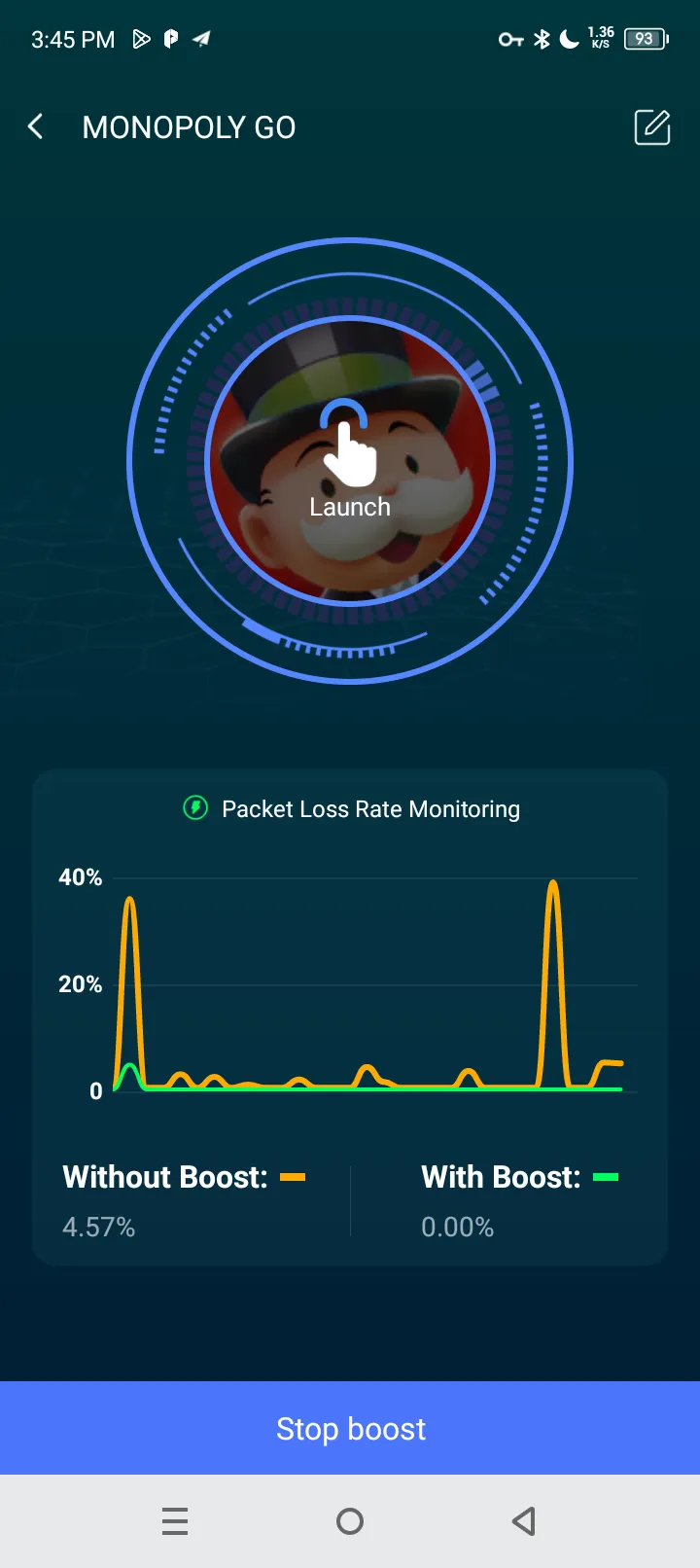
4. When there is significant high latency, packet loss, and jitter
If your biggest annoyance while gaming is high ping, fluctuating ping, character teleportation, or occasional malfunctions in controls, these all seem to be problems with the transmission path. As long as there's an alternative route, an accelerator can potentially be helpful.
Ⅳ. In what situations are game accelerators often less effective?
Having discussed the useful scenarios, we also need to clarify when they are less effective.
1. Unstable Local Wi-Fi or Home Network
For example, if you're connected to a weak Wi-Fi signal, separated by several walls, have an old router, or many devices are competing for bandwidth, the problem might arise before the data even leaves your home; the data is already unstable locally. No matter how much an accelerator optimizes the remote connection, it can't fix the initial fluctuations.
2. Poor Game Server Condition
Server maintenance, high load, data center instability, and official server malfunctions—these problems aren't on the path between you and the server, but at the destination itself. If the destination is unstable, no amount of repairs to the intermediate path will fundamentally improve the situation.
3. Insufficient Device Performance
Some players experience lag when there are many characters, stuttering during team battles, or choppy camera movements, suspecting a poor network connection. However, these issues are often closer to frame drops, excessive rendering pressure, or hardware bottlenecks. Accelerators can't improve your graphics card performance or instantly reduce CPU load; they offer little help for these problems.
4. Severe Bandwidth Congestion or Heavy Background Network Consumption
If your network is already strained, and background programs like downloading, video streaming, live streaming, and cloud synchronization are also consuming bandwidth, the effectiveness of an accelerator will be limited. This is because it optimizes the network path, not creates unlimited bandwidth.
V. Why Does It Work for Others but Not for You?
This is a common source of confusion.
Others say a certain accelerator works well, but when you try it, you find it only average; or for the same game, some say the effect is very noticeable, while others feel no difference.
The reason isn't complicated: everyone's network environment is significantly different.
1. Different Regions and Internet Service Providers
Different cities, different internet service providers, and different target server locations all affect the final effect. An accelerator isn't a tool that works uniformly for everyone; it works based on specific network conditions.
2. Different Times of Day
The level of network congestion differs greatly between daytime and nighttime. Some networks perform normally during the day but fluctuate significantly during peak evening hours. Therefore, what works well for others may not apply to your usual gaming times.
3. Different games and servers have different sensitivities.
Some games are particularly sensitive to network fluctuations, especially real-time competitive games like shooters and MOBAs; others are more tolerant of slight fluctuations. The same accelerator can have vastly different performance experiences in different games.
4. Inappropriate node selection.
Some people install accelerators with unsuitable default nodes, resulting in poor performance. Trying a different node, mode, or time of day can yield completely different results. Therefore, often it's not that "the accelerator is completely useless," but rather that "the current configuration is incompatible with your needs."
VI. How to determine if a game accelerator is truly effective.
If you really want to know if an accelerator is suitable for you, the best way is not to look at advertisements or recommendations, but to test it yourself.
1. Don't just focus on the Ping value.
Ping is important, but it's not the only indicator. Sometimes the ping may appear low, but you might still feel instability while playing because packet loss, jitter, or short-term fluctuations might not be reflected in a simple numerical value.
2. Observe Long-Term Stability
It's not enough for the first few minutes of smooth gameplay to consider it effective. You need to observe its stability over an entire game, an entire night, or even several consecutive days. Many products don't show problems in the short term, but the differences become apparent during peak hours, large-scale team battles, and long periods of online play.
3. Observe Actual Operation Feel
How responsive are skill releases? Does the character suddenly teleport? Is the shooting feedback normal? Has the disconnection frequency decreased? These factors are closer to the real experience than a single number.
4. Use a Trial Period for Comparison
The simplest method is to compare the difference between having it on and off in the same network environment. Try to experience it at similar times, in the same server, and in the same game. The conclusions drawn this way will be much more reliable than relying on reviews.
VII. Game Accelerators Are Not a Panacea, But They Are Not a Scam
At this point, the answer is quite clear.
Do game accelerators really work?
The answer is: For some problems, they are indeed effective; but for others, they are basically powerless.
1. It excels at solving network connectivity issues.
For example, high latency, packet loss, jitter, unstable cross-region connections, and network congestion during peak hours. If your problem falls into this category, an accelerator will usually be valuable and can even significantly improve your experience.
2. It can't solve all lag issues.
If you're experiencing poor local Wi-Fi, insufficient device performance, server malfunctions, heavy background network usage, or other issues that don't fall under the scope of network optimization, don't expect it to be a cure-all.
3. Whether it's worth using depends on your specific situation.
If you mainly play on domestic servers, local servers, and have a consistently stable network, using it might not make a significant difference. However, if you frequently play on international servers, cross-region servers, or often experience peak-hour fluctuations, ping spikes, or packet loss, it might be worth a try.
Ultimately, a game accelerator isn't magic; it's simply a tool for optimizing network routes. It's not a necessity for all players, but for some, it's a tool that can reliably improve their experience.
What's truly worth considering isn't someone else's "useful" or "useless" opinion, but rather your own network environment and actual experience.