Many people, when first encountering game accelerators and VPNs, think they're similar.
On the surface, they do have some similarities. For example, both will "reroute" your network connection, and both will change the way you connect to the target server to some extent. To the average user, it looks like "switching networks," "using a relay," or "changing routes."
Because of this, many people naturally wonder: since VPNs can also change routes, can they directly replace game accelerators? Or conversely, are game accelerators simply VPNs specifically for gaming?
The answer is clearly no.
These two tools may seem similar on the surface, but their essence, goals, and use cases are completely different. You can think of them as two tools with entirely different purposes that just happen to be related to network connectivity.
If your need is for gaming, especially international servers, cross-region servers, or latency-sensitive games, then a game accelerator is usually more suitable.
If your needs are for general network access, privacy protection, remote work, or encrypted transmission, then a VPN is the more appropriate tool.
Therefore, this article doesn't aim to clarify which is "more advanced," but rather to explain their differences and in what situations you should use which.
I. Game accelerators and VPNs are not the same thing
Many discussions go around in circles because people implicitly categorize them as "proxy tools." This categorization isn't entirely wrong, but it's too broad, easily obscuring the key differences.
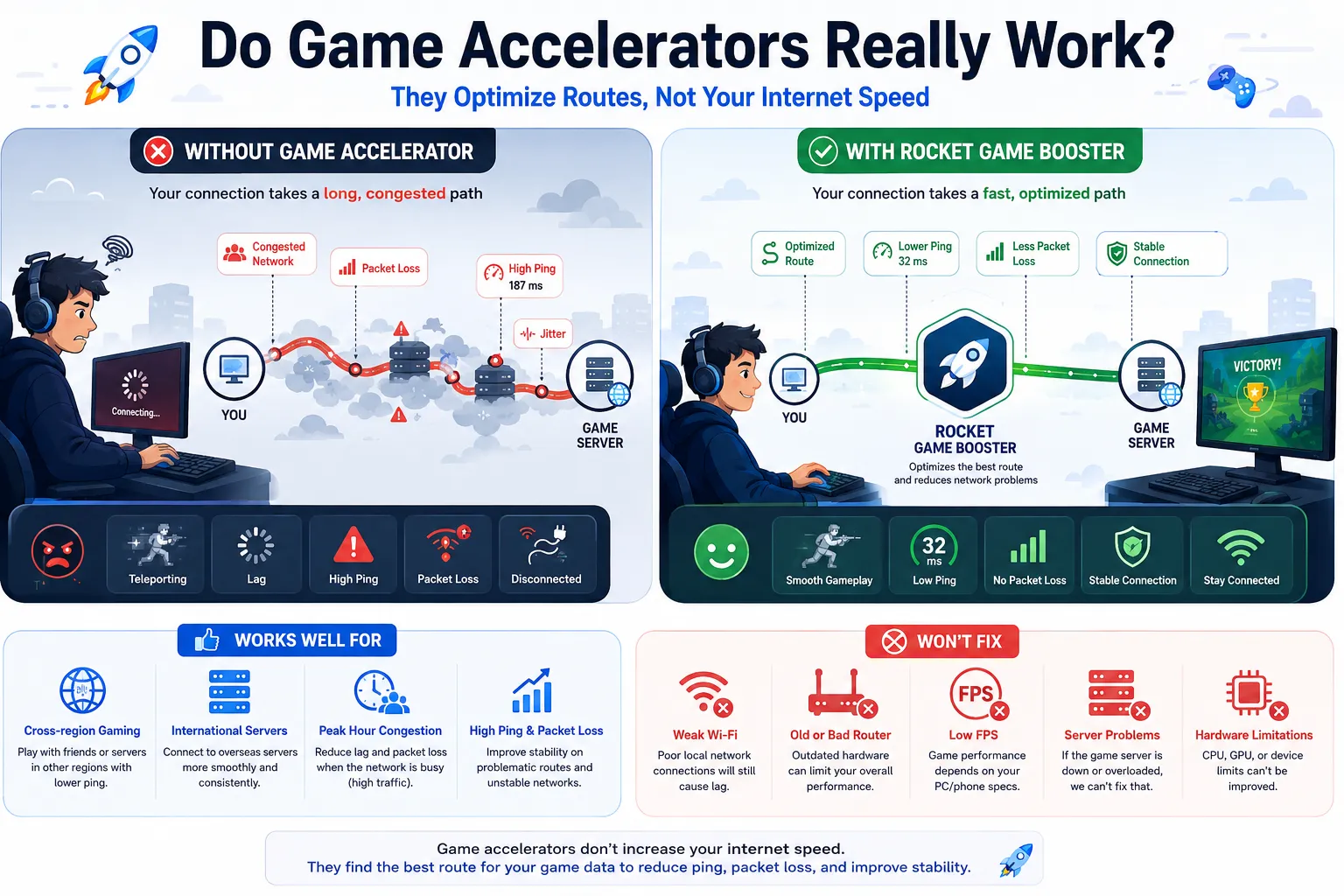
Game accelerators focus more on game network optimization. Their core goal is clear: to make your network more stable while gaming. They address issues like latency, packet loss, jitter, and cross-region connection quality. In short, they don't aim to get you "up," but to make your "game run smooth."
VPNs focus more on general network access and privacy protection. Their focus isn't specifically on game optimization, but on establishing an encrypted tunnel to forward your traffic through a unified channel. Often, their more common uses are privacy protection, remote access, cross-region access to certain services, or internal corporate network connections.
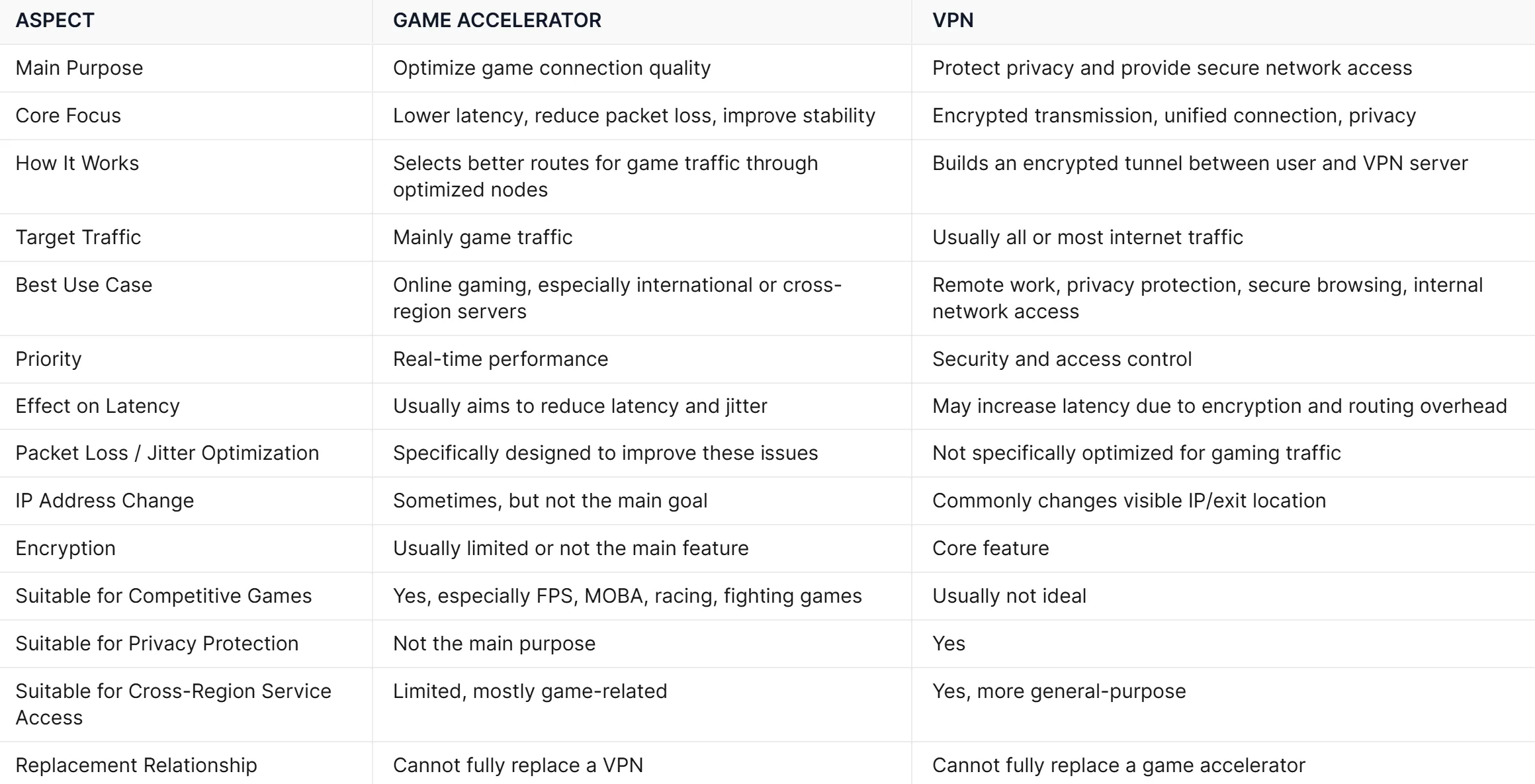
Therefore, they solve different problems. Game accelerators address the issue of "game connection quality"; VPNs address the issue of "universal connection methods and transmission security."
They overlap, but cannot simply replace each other.
II. How They Each Work
If you only look at the usage, they are quite similar: open the client, select a node, and connect. But the underlying principles are actually quite different.
1. Game Accelerators: Focus on "Route Selection"
The core of a game accelerator's operation is to find a more suitable transmission path for your game data.
Normally, your device will connect to the game server according to the default path provided by your ISP. However, the default path is not necessarily the best; it may involve detours, congestion, or generally poor quality when crossing ISPs. The accelerator's role is to use its own node network to first connect your data, and then try to select a more stable and smoother route to send it to the game server.
Therefore, it's more like a tool specifically for route scheduling for games.
2. VPNs: Focus on "Tunnel Building"
The focus of a VPN is on establishing an encrypted connection. It first establishes a tunnel between your device and the VPN server, then forwards all traffic through this tunnel.
The advantage of this is a more unified connection method, and it's better suited for handling privacy and security needs. Often, it focuses on whether the transmission process is encrypted and whether the exit point is unified, rather than which route a particular game uses for lower latency.
Simply put, game accelerators care more about "how easy the route is," while VPNs care more about "whether it's using a unified and encrypted method."
III. Why is the experience so different in gaming scenarios?
When browsing the web or watching videos, many people may not notice the difference between the two. However, in gaming scenarios, especially real-time competitive games, the difference becomes rapidly amplified.
This is because games have different network requirements than regular internet browsing.
It cares less about "whether you can connect," and more about:
- Low latency
Severe packet loss
High jitter
Long-term connection stability
Shooting, MOBA, fighting, and racing games are particularly sensitive to these metrics. Every movement, shot, and skill activation you make involves real-time interaction with the server. Even the slightest noticeable fluctuation will immediately degrade the gameplay experience.
This is precisely where game accelerators excel. Designed specifically for game traffic, they prioritize selecting the most suitable network for specific games, servers, and time periods.
VPNs are different. While they also alter the connection path, they don't necessarily prioritize real-time performance. Sometimes, they might even add extra steps to the data route or incur additional overhead due to encryption and unified forwarding. For regular internet browsing, this difference might be minor; however, for games, it can be enough to make the connection feel unresponsive.
Therefore, in gaming scenarios, the ability to change the network route doesn't guarantee suitability for gaming.
IV. Which Scenarios Are Game Accelerators Best For?
If your core need is gaming, then game accelerators are generally more valuable in the following scenarios:
For example, playing on international servers or cross-region servers.
This is almost the most typical use case. Players and servers are already far apart; even a slightly weaker default network will amplify latency and fluctuations. Game accelerators, through relaying and line selection, generally stabilize connections more easily.
Another example is peak-hour network congestion.
Many people play games fine during the day, but experience ping spikes, packet loss, and disconnections at night. This is usually related to public network congestion. If an accelerator can bypass congested lines, the effect is often more noticeable.
Another issue is unstable connections across different ISPs.
Sometimes the problem isn't that your home broadband is slow, but rather the poor interconnection quality between your current ISP and the target server. Normal speed tests don't guarantee smooth gameplay. Accelerators are more effective in this scenario.
Another common situation is that what bothers you most isn't high absolute latency, but network instability.
For example, ping might not be particularly high, but it fluctuates wildly, or your character might occasionally teleport. If the root cause of these problems is link quality, game accelerators are usually more effective than VPNs.
V. Which Scenarios Are VPNs Better For?
VPNs aren't useless, but their strengths lie in different areas than game accelerators.
It's better suited for these needs:
- General network access
- Privacy and data encryption
- Remote work
- Cross-regional access to internal services
- Unified egress management
These needs share a common concern: they prioritize a consistent connection method, secure data transmission, and controllable access permissions, rather than simply minimizing latency for a particular game.
Therefore, if your primary goal isn't gaming, but rather broader connectivity needs, a VPN is often more suitable. It's not specifically designed for gaming optimization, but it has clear value in scenarios involving security, access, and encryption.
VI. Common Misconceptions
Game accelerators and VPNs are often discussed together largely because many people's expectations are misplaced from the start.
1. Mistakenly believing that a VPN can completely replace a game accelerator
VPNs can indeed modify routes, but "can modify" doesn't equate to "can optimize." For games, the key isn't whether you're using a proxy, but whether that route is truly friendly to real-time transmission.
2. Mistakenly believing that changing your IP address will guarantee a smoother gaming experience.
Changing your IP address and network stability are not the same thing. Gaming experience is more about latency, packet loss, jitter, and link quality, not simply changing your exit point. Focusing solely on IP changes can easily lead to missing the point.
3. Mistakenly believing that game accelerators and VPNs are both superior.
This is not the case. Tools are not inherently superior or inferior; they are simply suitable for each other. Comparing a hammer and a screwdriver is meaningless. The key is whether you are tightening screws or hammering nails.
Ultimately, it depends on your intended use.
If your core goal is a better gaming experience, then prioritize a game accelerator.
If your core goal is privacy, encryption, and remote access, then a VPN is more suitable.
VII. How to Choose: Should You Use a Game Accelerator or a VPN?
When actually choosing, don't overcomplicate the issue. Just focus on your own needs, and the answer is usually clear.
If your core need is gaming, especially international servers, cross-region servers, and games with high real-time response requirements, then prioritize a game accelerator. This is because its design goal is to reduce latency, minimize packet loss, and improve stability.
If your primary needs are secure transmission, a unified exit point, access to internal services, or broader network connectivity requirements, then a VPN is a more suitable tool.
The worst approach is to expect a VPN to optimize games like a game accelerator, while simultaneously expecting a game accelerator to handle general privacy and security needs like a VPN. This judgment will only result in both being deemed "inadequate."
Therefore, when choosing a tool, the most important factor is not "which has a bigger reputation," but "what problem do you actually want to solve?"
VIII. They are not opposites, but two completely different tools.
Returning to the initial question, what is the difference between a game accelerator and a VPN?
Ultimately, the difference lies in what they focus on.
Game accelerators primarily address issues directly related to the gaming experience, such as latency, packet loss, jitter, and cross-region connection stability. Its value lies not in its seemingly more complex technology, but in its better suitability for the gaming scenario.
VPNs are better suited for encrypted transmission, remote access, unified gateways, and privacy protection. These capabilities are important, but they don't automatically make them suitable for gaming.
Therefore, they are not replacements for each other, nor are they necessarily superior. What's truly important is understanding what problem you're trying to solve.
If the problem is "Why do I always experience high latency, packet loss, and ping spikes when gaming?", then you probably shouldn't be looking at a VPN.
If the problem is "I need a more unified and secure connection," then don't expect a game accelerator to do the work of a VPN for you.
The biggest mistake when choosing tools isn't choosing the most expensive one, but starting with the wrong approach.